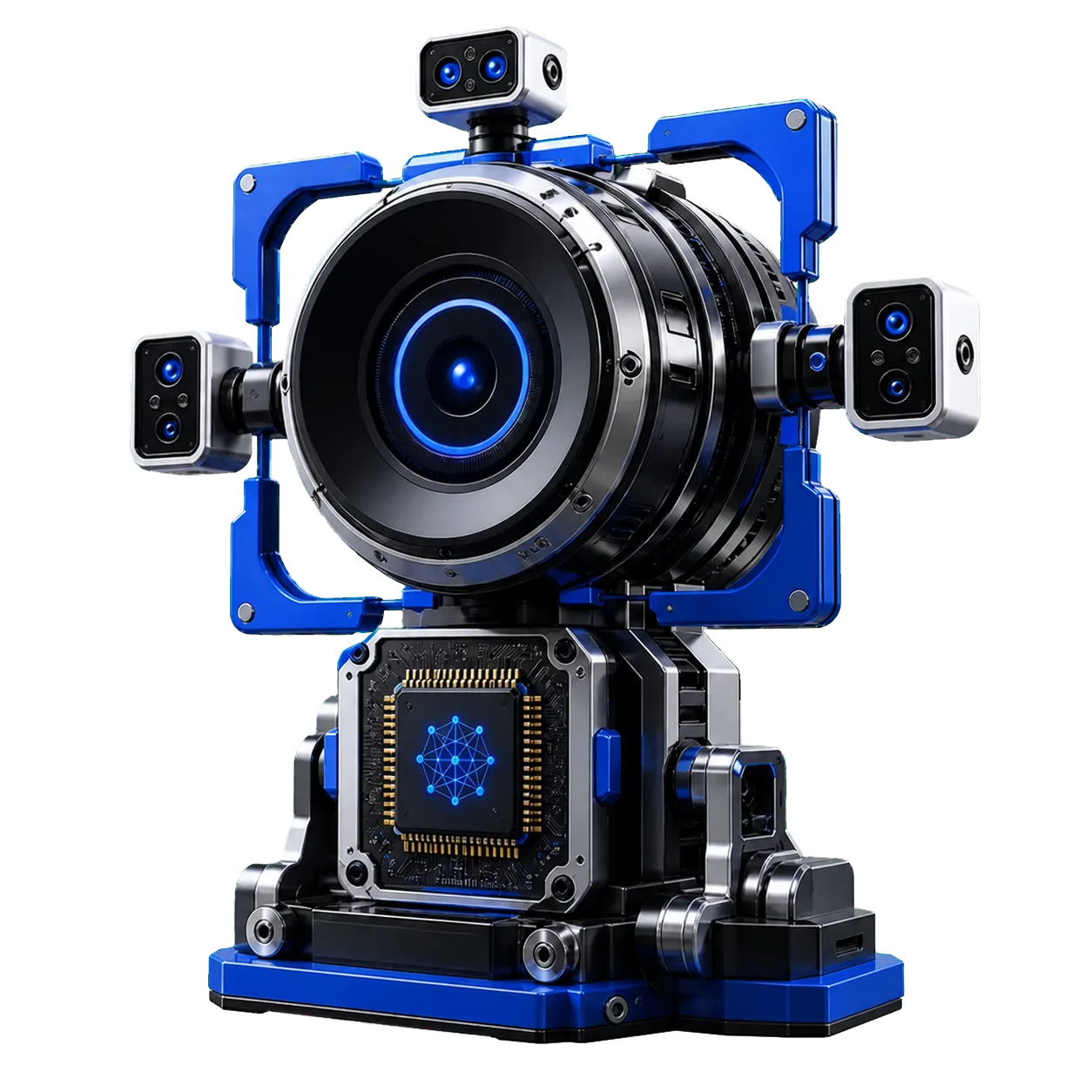
Deep Learning for Computer Vision in Industrial AI is a practical, production-oriented course that teaches how modern computer vision systems are designed, trained, optimized, deployed, and maintained in real-world industrial environments.
The course is designed for engineers, AI practitioners, data scientists, researchers, product teams, and technical leaders who want to move beyond model training and understand how computer vision becomes a reliable production system.
Students will learn core vision architectures and workflows, including CNNs, ResNet, EfficientNet, Vision Transformers, YOLO, SAM, segmentation, tracking, video understanding, generative vision models, explainability methods, Edge AI, model compression, deployment, MLOps, governance, robustness, and industrial system integration.
By the end of the course, learners will understand not only how computer vision models work, but how to turn them into scalable, trustworthy, and business-relevant AI systems for manufacturing, healthcare, robotics, logistics, safety, and other industrial domains.
All exercise files are here: https://github.com/Barak28/DL4CV
Production-oriented computer vision
Move beyond model training and engineer a dependable vision system
Deep Learning for Computer Vision connects modern architectures to the complete industrial lifecycle: data, training, evaluation, optimization, deployment, monitoring and governance. It is built for practitioners who need systems that work outside the notebook.
Course overview
What the curriculum covers
Six topics and 36 lessons span the methods and engineering decisions behind modern visual AI.
Image classification with CNNs, ResNet and EfficientNet.
Vision transformers and modern representation learning.
Object detection, segmentation, tracking and video understanding.
Generative vision models, robustness and explainability.
Edge AI, compression, deployment and MLOps workflows.
Designed around real deployment constraints
The course treats accuracy as one requirement among many. You will also reason about latency, hardware, data shift, monitoring, traceability and the operational context in which a prediction becomes a decision.
Industrial examples from manufacturing, healthcare, robotics, logistics and safety.
Google Colab notebooks and solution material.
A practical bridge between research models and production systems.
Recommended background
Basic Python and machine-learning knowledge are recommended. Advanced computer-vision experience is not required, but learners should be comfortable running notebooks and interpreting model metrics.
AI and machine-learning practitioners.
Software and automation engineers.
Researchers, advanced students and technical product leaders.
Frequently asked questions
Does the course include code?
Yes. It includes downloadable Colab notebooks, solution notebooks and practical computer-vision workflows.
Is deployment covered?
Yes. The curriculum addresses optimization, Edge AI, model compression, serving, monitoring, MLOps and industrial integration.
Where are the exercise files?
The course links to the maintained exercise repository and provides guided material for the practical workflow.