
About Course
From a prediction question to a defensible model
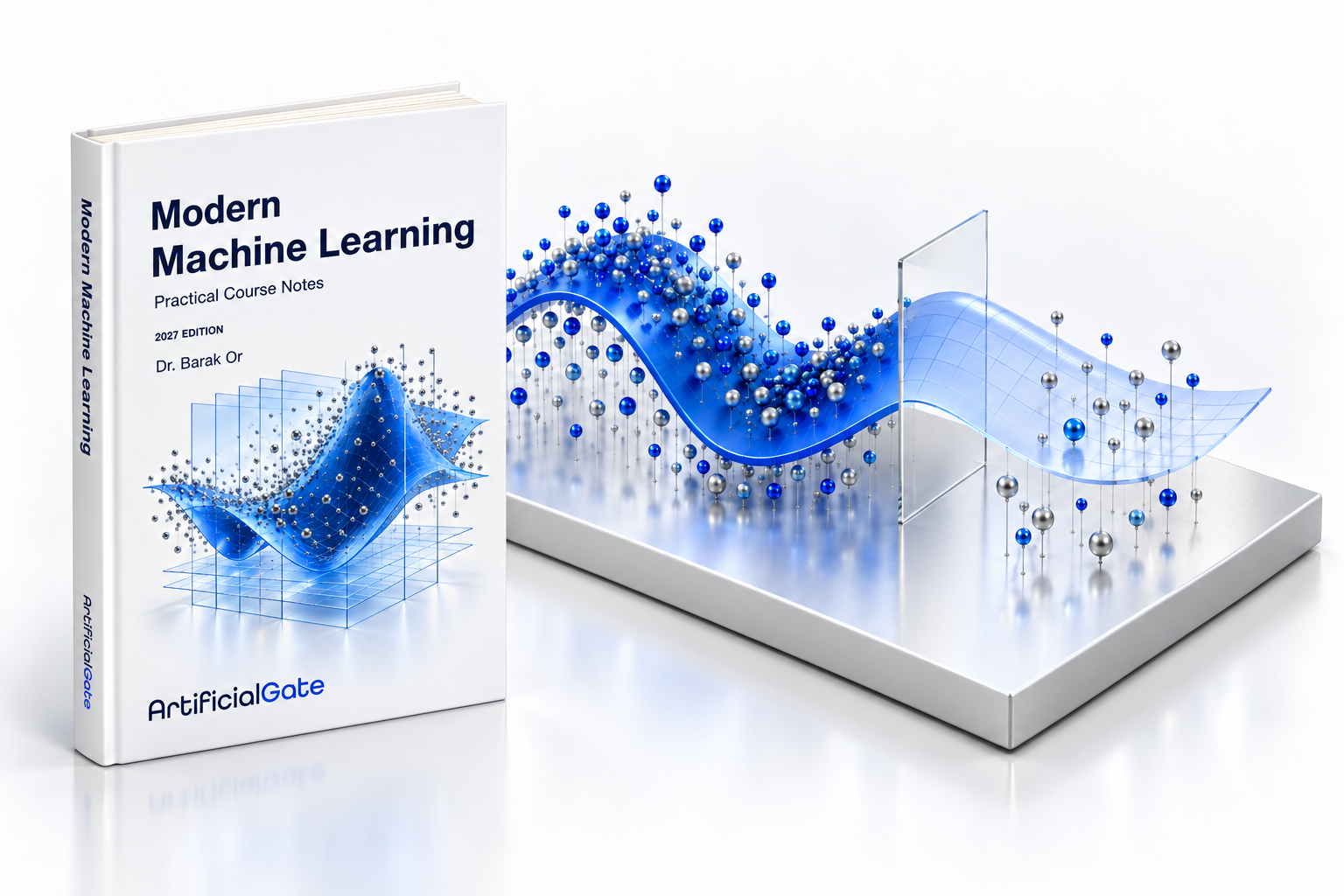
Learn machine learning by building models, testing assumptions and explaining evidence. This English-language course follows Modern Machine Learning, 2027 edition, by Dr. Barak Or. It develops practical skill alongside the mathematical ideas needed for reliable experimentation and later deep-learning study.
What is included
- 13 chapters covering foundations, classical models and neural-network principles.
- 26 core Python notebook exercises and 13 real-data case studies, suitable for upload to Google Colab.
- 65 multiple-choice knowledge-check questions with explanatory feedback.
- 13 chapter-aligned interactive investigations on real benchmark observations, plus the preserved Iris practice lesson.
- A complete textbook, a readiness diagnostic, an independent transfer check and a rubric-based capstone.
Video recordings are not yet available. The 39 planned short lessons are available now as complete readable scripts.
Download Modern Machine Learning · Download the learner notebook pack
The learning path
- ML Problems, Data, and Generalization
- Regression, Optimization, and Regularization
- Classification and Imbalanced Data
- Validation and Model Selection
- Representations, PCA, and PLS
- Distance, Margins, and Kernels
- Trees and Ensemble Learning
- Clustering and Anomaly Detection
- Probability Calibration and Model Diagnosis
- Gaussian Processes and Experiment Selection
- Neural Network
- Training and Debugging Neural Networks
- Text Classification and Embeddings
Real datasets, explicit assumptions
Practice includes Iris, Diabetes, Wisconsin Diagnostic Breast Cancer, California Housing, Wine Quality, handwritten Digits, Adult, Wine, MNIST, Fashion-MNIST and 20 Newsgroups. The browser simulators use identified real benchmark observations. Carefully labeled constructed examples remain in the textbook and mathematical notebook exercises where their assumptions are the object of study.
Build an evidence portfolio
Complete the course by assembling reproducible code, experiment settings, comparisons against a baseline, held-out results and a written failure analysis. Quizzes and rubrics are educational self-assessments, not a claim of validated professional certification.
Who this is for
- Engineers, analysts, researchers and students who want an applied, mathematically grounded introduction to machine learning.
- Independent learners preparing for deeper study of deep learning.
- Practitioners who want stronger experimental design, evaluation and failure-analysis habits.
Before you begin
- Working knowledge of Python functions, loops and NumPy arrays.
- Basic vectors, matrices, derivatives, averages and probability; a diagnostic and repair guidance are included.
- A browser and a Python environment; the notebooks can be uploaded to Google Colab.
- Some dataset downloads require internet access. Use a CPU runtime for the core exercises.
Course Content
01 | ML Problems, Data, and Generalization
Start Here: Your Learning Path and Downloads
Chapter 1: Reading and Learning Goals
1. Specify the question before trusting the fit — Readable Lesson; Video Pending
2. Turn model comparison into independent evidence — Readable Lesson; Video Pending
3. When geometry and repeated fitting tell different stories — Readable Lesson; Video Pending
Core Practice A: Approve a prediction contract and defend the chosen loss
Core Practice B: Challenge a dimensionality claim with a changed dependence structure
Real-Data Case Study: Iris: write the prediction contract before chasing accuracy
Interactive Lab: Sampling and Generalization
Readiness Diagnostic: Python, Shapes and Mathematical Tools
Chapter 1 Knowledge Check
01 | ML Problems, Data, and Generalization
02 | Regression, Optimization, and Regularization
02 | Regression, Optimization, and Regularization
03 | Classification and Imbalanced Data
03 | Classification and Imbalanced Data
04 | Validation and Model Selection
04 | Validation and Model Selection
05 | Representations, PCA, and PLS
05 | Representations, PCA, and PLS
06 | Distance, Margins, and Kernels
06 | Distance, Margins, and Kernels
07 | Trees and Ensemble Learning
07 | Trees and Ensemble Learning
08 | Clustering and Anomaly Detection
08 | Clustering and Anomaly Detection
09 | Probability Calibration and Model Diagnosis
09 | Probability Calibration and Model Diagnosis
10 | Gaussian Processes and Experiment Selection
10 | Gaussian Processes and Experiment Selection
11 | Neural Network
11 | Neural Network
12 | Training and Debugging Neural Networks
12 | Training and Debugging Neural Networks
13 | Text Classification and Embeddings
13 | Text Classification and Embeddings
Student Ratings & Reviews
